Depending on the dredging soil conditions, a Trailing Suction Hopper Dredger (TSHD) must be equipped with appropriate drag head and teeth to ensure dredging efficiency, slurry concentration, and operational safety. Proper selection improves production capacity while reducing equipment wear and energy consumption.
Types of Drag Head
Based on their working principles, drag heads used on TSHD are generally classified into three main types:
-
Flushing-type drag heads
-
Cutting-type drag heads
-
Active cutting drag heads
The selection of a drag head should be based on the dredged soil type and density, as each drag head type is designed for specific ground conditions.
- Flushing-Type Drag head
The flushing-type drag head, typically represented by the California drag head, relies mainly on hydraulic flushing. When the dredge pump operates, a vacuum is created inside the drag head, generating a pressure difference with the surrounding water. Water enters the drag head through the gaps between the drag head and seabed at high velocity, flushing and entraining surrounding sediments into the suction pipe.
This type of drag head generally produces lower slurry concentration and output. With technological advancements, modern flushing drag heads are usually equipped with high-pressure water jets to enhance dredging efficiency.
Suitable soil types:
-
Organic soils
-
Peat
-
Silt and silty soils
-
Soft clay
-
Loose to medium-dense sand (with high-pressure water jets)

2. Cutting-Type Drag head
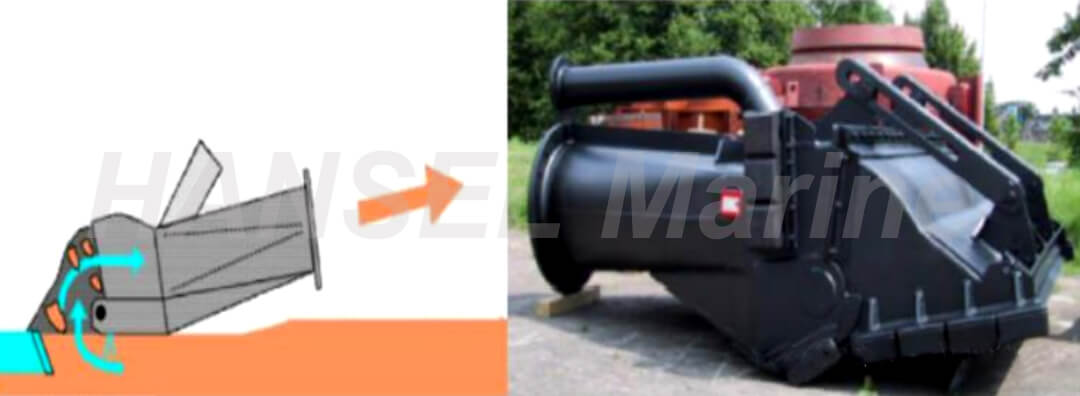
The cutting-type drag head, represented by the IHC drag head, relies on drag head teeth to mechanically cut the soil, combined with high-pressure water jets to loosen the material. This significantly increases slurry concentration and dredging output.
Cutting edges or drag head teeth can be installed to enhance mechanical cutting performance, making this type suitable for general cohesive soils.
3. Active Cutting Drag head
The active cutting draghead, represented by the “Weilong Drag head”, is equipped with hydraulic cylinders that control an adjustable visor or hood, significantly enhancing cutting and excavation performance.
It is suitable for dense sand, stiff clay, and loose gravelly soils. For loose gravel and highly weathered rock, drag heads fitted with coarse teeth are recommended to improve breaking capability.
Types of Drag Head Teeth

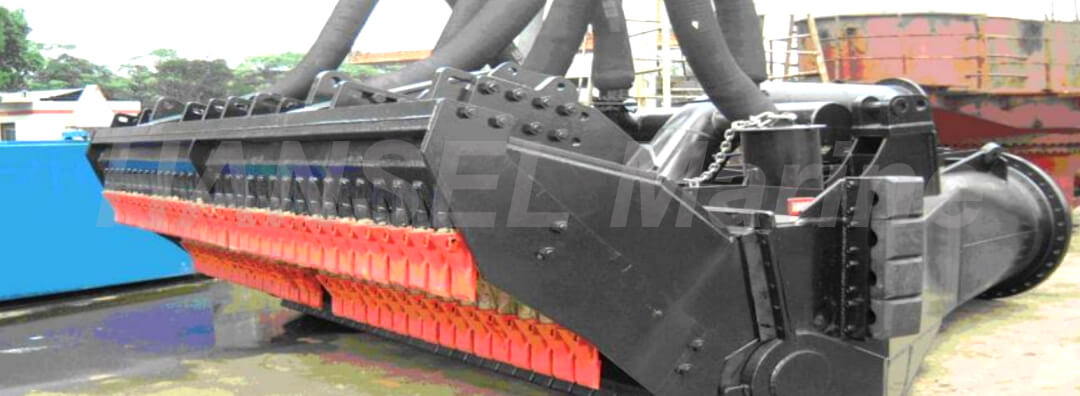
When hydraulic flushing alone cannot meet dredging requirements, drag head teeth are used to significantly improve efficiency. Different shapes and types of teeth disrupt soil structure and cohesion, allowing material to be more easily sucked into the pipeline.
By shape, drag head teeth are classified as:
-
Chisel-type teeth: Suitable for organic soils, peat, silt, fine sand, and medium sand (high-pressure water recommended)
-
Pointed teeth: Suitable for silt, fine sand and coarser materials, as well as gravelly soils (with high-pressure water jets)
-
Plough-type teeth: Suitable for cohesive soils