1. Influence of Cutter Head Profile on Step Length
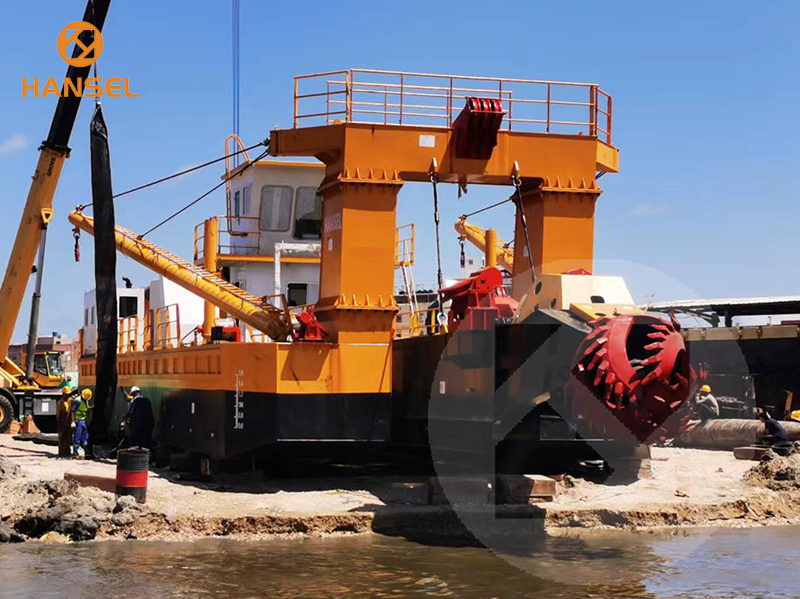
Due to the arc-shaped longitudinal profile of the cutter head, a shallow point may form between two adjacent swing-cut sections during dredging.
If the forward step length is excessive, this shallow area becomes more pronounced, which may negatively affect dredging quality, especially in formation layers requiring high accuracy.
Therefore, the forward step length should be carefully controlled based on the cutter head geometry, size, and ladder lowering angle, avoiding excessive advancement.
In non-formation dredging operations such as general sand or silt removal, this effect is less critical and may be considered negligible.

2. Effect of Dredging Layer Thickness on Swing Resistance
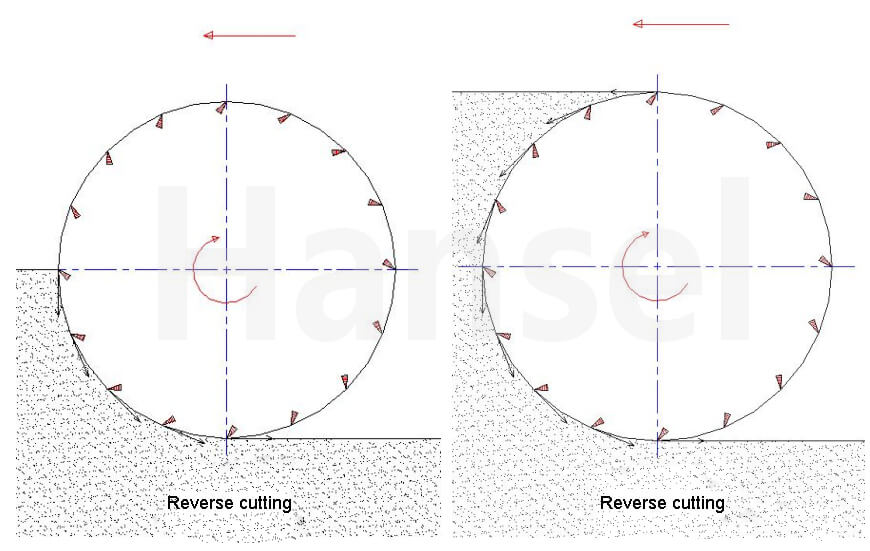
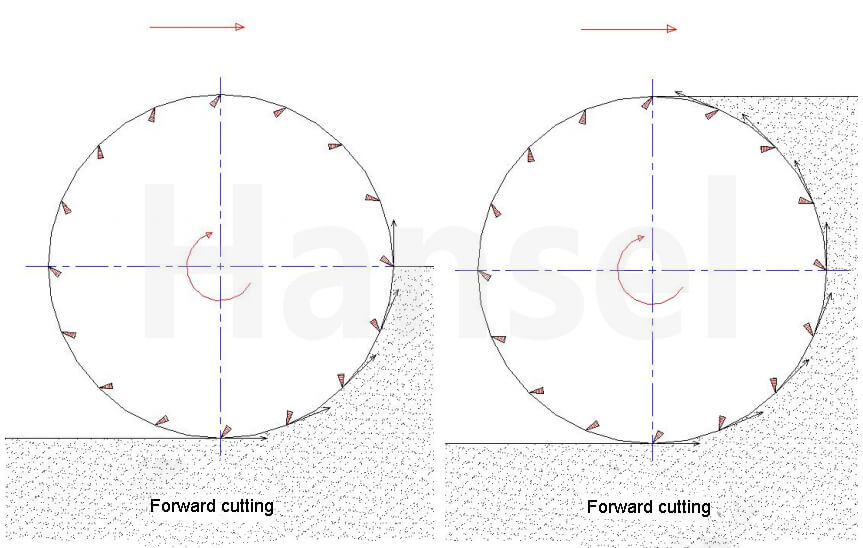
When the dredging layer is thin, only the lower-left cutter teeth are involved in cutting. The reaction force generated by cutter rotation can be decomposed into a vertical downward force and a horizontal force acting on the cutter head.
The horizontal component must be balanced by swing pulling force, resulting in increased swing resistance.
When the dredging layer thickness increases, most cutter teeth on the left side of the cutter head participate in excavation. In this case, the reaction forces acting on the upper and lower cutter teeth tend to offset each other, causing the overall horizontal reaction force to approach zero.
As a result, the demand for swing pulling force is significantly reduced.
For projects with limited swing pulling capacity, adopting a dredging process with increased cutting layer thickness and appropriate forward step length can effectively improve operational performance.
This principle applies to both forward and reverse cutting modes. A thicker dredging layer helps balance internal forces within the cutter head, reduces swing resistance, and also mitigates the risk of cutter rolling.
Force analysis shows that with a thin cutting layer, the resultant force in the vertical direction may be upward, while with a thicker layer, the vertical resultant force approaches zero, contributing to improved cutter stability.
3. Influence of Swing Speed and Cutter Rotation Speed on Chip Thickness
For both forward and reverse cutting, the maximum chip thickness can be estimated using the following formula:
Maximum chip thickness = Swing speed (m/min) ÷ Cutter rotation speed (rpm) ÷ Number of cutter arms
Smaller chip thickness results in lower cutting resistance per tooth.
When dredging rock, dense sand, or hard clay, it is recommended to increase the cutter rotation speed and adjust the swing speed accordingly, thereby reducing cutting resistance and fully utilizing cutter drive power.
For soils with low cutting resistance and favorable excavation conditions, the cutter rotation speed may be reduced while increasing chip thickness, helping to optimize energy consumption and improve operational efficiency.