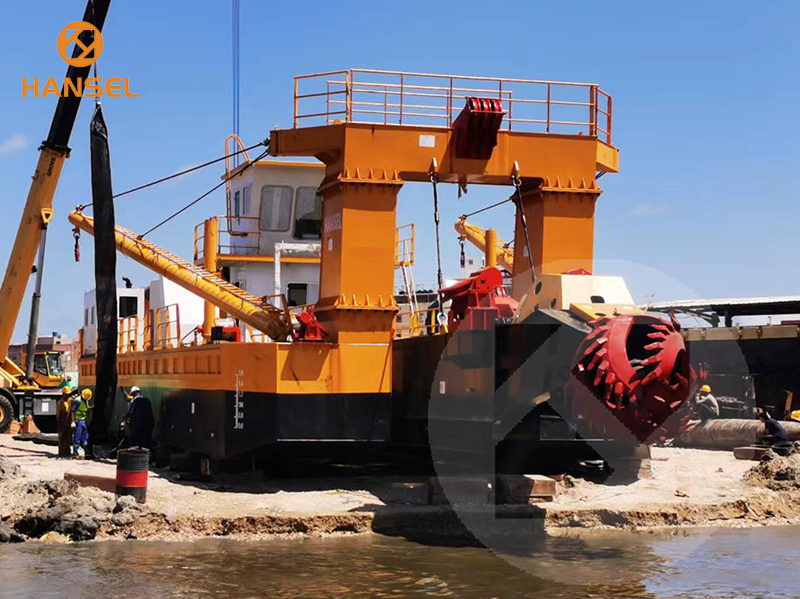
Successful cutter suction dredger (CSD) operations depend not only on vessel capability and dredging parameters, but also on a comprehensive assessment of environmental conditions at the project site. Prior to mobilization, a detailed analysis of environmental factors is essential to ensure safe, efficient, and continuous dredging operations.
1. Water Depth
Before construction, a thorough analysis of bathymetric charts of the working area and surrounding waters should be carried out. Key considerations related to water depth include:
- Whether the water depth in the dredging area meets the requirements for vessel positioning and spud operation.
- Whether the water depth satisfies the minimum dredging depth capability of the cutter suction dredger.
- Whether the available water depth allows for the minimum swing width required during dredging operations.
- Whether the water depth in the working area and adjacent waters is sufficient for anchor handling vessels during anchor deployment and retrieval operations.
- Whether the water depth allows for the assembly, adjustment, and operation of floating and submerged pipelines.
- Whether the water depth is adequate for loading and unloading spare parts and equipment.
- Whether the water depth and site conditions allow for safe crew embarkation and disembarkation.
A clear understanding of these factors helps avoid operational restrictions and unexpected delays during construction.
2. Current Conditions
A comprehensive assessment of current conditions in the working area and surrounding waters is required prior to construction. The following aspects should be carefully evaluated:
- Measurement and analysis of current velocity and direction in the dredging area and nearby waters.
- Evaluation of the impact of currents on dredger swing motion and operational stability.
- Coordination between dredger orientation, pipeline layout, and prevailing current direction, with the dredger preferably aligned parallel to the current flow.
- Assessment of submerged pipeline behavior under current action, including buoyancy control, pipeline anchoring weight, and the length and diameter of anchor wires.
Proper consideration of current conditions is essential for maintaining dredging accuracy and protecting pipelines from excessive stress or displacement.
3. Wave Conditions
Wave conditions are a critical environmental factor in marine dredging projects, directly affecting operational safety, positioning accuracy, and construction efficiency.
The influence of waves on cutter suction dredger operations can be summarized as follows:
- Impact on vessel stability and operational safety
Excessive wave height can cause significant heave, roll, and pitch of the dredger, reducing spud stability and increasing structural loads on the cutter ladder and hull. In severe sea states, dredging operations may need to be suspended to ensure equipment and personnel safety. - Impact on positioning accuracy and dredging quality
Vessel motion induced by waves can negatively affect swing control and positioning precision, resulting in uneven dredging profiles and reduced excavation accuracy. - Impact on floating and submerged pipelines
Wave action increases dynamic loads on floating pipelines, while submerged pipelines may experience additional stress due to vertical movement and hydrodynamic forces. Proper design of float spacing, anchor weights, and mooring arrangements is therefore essential to minimize fatigue and potential damage. - Limitations on construction windows
During project planning, historical wave and meteorological data should be analyzed to identify suitable construction seasons and weather windows, ensuring stable and continuous dredging operations.
4. Pipeline Assembly Area Conditions
Pipeline assembly conditions play a significant role in determining construction efficiency and logistics planning. The following factors should be evaluated in advance:
- Whether suitable onshore areas are available near the dredging site for pipeline assembly, and whether access roads allow for the transportation of pipes and construction equipment.
- Whether the water depth near the pipeline assembly area meets the requirements for towing pipelines by anchor handling vessels.
- Whether the water depth and surrounding conditions near the dredger allow for pipeline assembly using the dredger’s onboard lifting equipment.
Adequate preparation of pipeline assembly areas helps streamline installation work and reduce offshore operation time.
Environmental factors such as water depth, currents, waves, and pipeline assembly conditions have a direct and significant impact on cutter suction dredger operations. A comprehensive site investigation and environmental assessment prior to construction not only improve operational efficiency but also enhance safety and reduce project risks.
Careful planning and adaptation to local environmental conditions are key to the successful execution of cutter suction dredging projects.